
newsletter 03/05/24
Starting off 2024 with More Accountability
Institute for Constitutional Advocacy and Protection
GEORGETOWN LAW
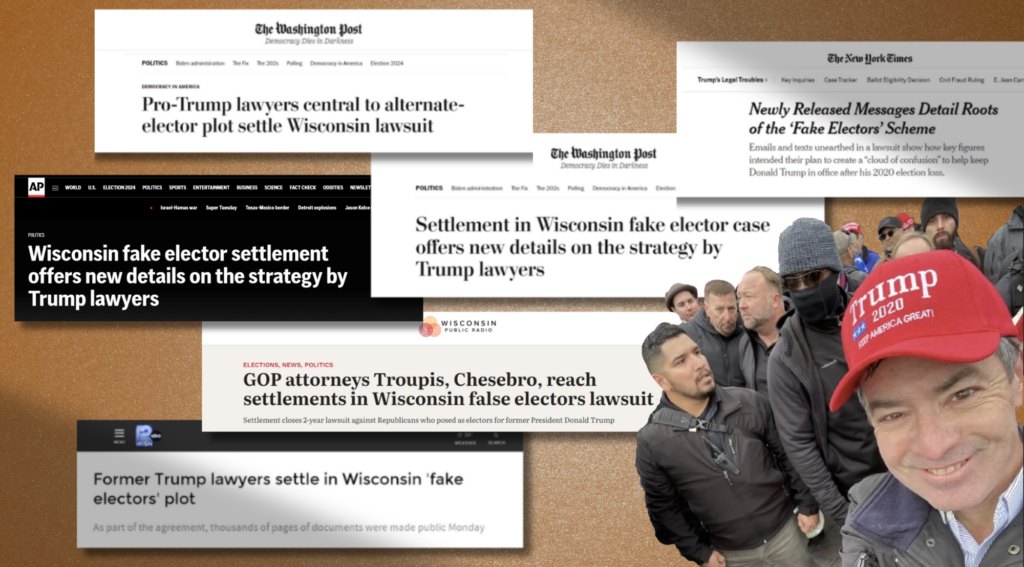
Adding to the accountability we obtained for voters in Wisconsin and nationwide when we resolved our lawsuit against Wisconsin’s 10 fraudulent electors in December, we’re thrilled to announce that we have now held accountable the two remaining defendants in that case: Trump’s Wisconsin campaign attorney, James Troupis, and the architect of the fraudulent elector scheme, Kenneth Chesebro. In settling the case we brought on behalf of legitimate Wisconsin presidential electors and voters, we obtained the agreement of both Troupis and Chesebro not to participate in a similar scheme in any future presidential election, as well as troves of emails, texts, and other documents showing that:
- Troupis and Chesebro conceived of the fraudulent electors scheme just days after the November 3 election;
- Troupis shared the scheme, and legal memos he asked Chesebro to write, with Trump campaign officials at the national level, who eagerly sought to implement it in other swing states beyond Wisconsin;
- At the Trump campaign’s request, Troupis instructed Chesebro to prepare electoral college documents for Trump campaign officials in other states;
- The Troupis-Chesebro plan was not just a contingency in case litigation resulted in Trump being declared the winner in any of the swing states; rather, the scheme was implemented to use the fraudulent ballots to create chaos on January 6, regardless of whether litigation was successful, thereby creating an opportunity to overturn the results of the election; and
- Troupis and Chesebro were involved in last-ditch efforts up to and including January 6 to get the fraudulent Wisconsin electoral ballot certification into the hands of the Vice President.
The resolution of this litigation provides much-needed transparency into how the fraudulent electors scheme was conceived and developed, and it exposes the key roles of Troupis and Chesebro in the execution of the scheme in Wisconsin and nationally. By shining light on the blatant effort to overturn the results of the 2020 election, it is our hope that Americans will resolve to ensure that nothing like this happens ever again. We are grateful to the plaintiffs for having the courage to bring this case and to our co-counsel from Law Forward and Stafford Rosenbaum for working with us to achieve this result.
Read some of the coverage here: The New York Times, The Washington Post, and AP.

In another victory for democracy, last week the U.S. Court of Appeals for the Fourth Circuit unanimously upheld student school board participation in Howard County, Maryland, rejecting claims that the student-election process for selecting the voting student member of the school board violates the U.S. Constitution. This was ICAP’s second win on this issue, having also defeated a parallel challenge under the Maryland Constitution. These decisions provide a firm grounding in both federal and state law for Maryland’s efforts to expand public school students’ participation in the governance of their schools and to train students as citizens in a democracy.
ICAP also achieved success on behalf of the South Carolina State Conference of the NAACP after challenging the state’s prohibition on the unlawful practice of law—a broadly interpreted prohibition that threatened an NAACP program that will provide much needed basic legal guidance to the many South Carolinians facing eviction who currently lack access to any legal help. The state Supreme Court, reviewing the issue, agreed to a three-year authorization of the pilot program to demonstrate the efficacy of the non-lawyer housing advocates.
In the ongoing battle over affirmative action in higher education, ICAP was proud to file an amicus brief on behalf of current and former U.S. Army officers in their personal capacities, explaining why racial diversity at West Point is necessary to ensure a more lethal and effective Army. After we filed our brief, the district court denied a request to halt the U.S. Military Academy’s use of race in the admissions process, and the U.S. Supreme Court declined to intervene.
And in the U.S. Supreme Court:
Defeating a petition for Supreme Court review, ICAP successfully preserved an important Sixth Circuit decision in favor of our client, Julie Helphenstine, whose husband died in pretrial detention after jail guards failed to seek medical care for him. The denial of review keeps in place the Sixth Circuit’s favorable standard for claims arising from the deprivation of medical care for pretrial detainees, and marks the sixth petition for certiorari that ICAP defeated over the last year.
Looking forward, ICAP is involved in two cases the Supreme Court will hear this spring:
In March, ICAP’s faculty chair, Neal Katyal, will argue on behalf of former Superintendent of the New York City Department of Financial Services Maria Vullo, in National Rifle Association v. Vullo. Our brief defends the right of government officials to enforce the law and to speak out about matters of public concern without fear that their statements will subject them to litigation by entities—like the NRA—that espouse controversial views.
In April, ICAP’s Supreme Court Director Kelsi Corkran will argue Grants Pass v. Johnson, on behalf of the homeless residents of Grants Pass, Oregon, who brought suit to challenge a set of ordinances that make it unlawful to sleep or rest anywhere on public property with so much as a blanket to survive cold nights, even if shelter is unavailable. The question before the Court is whether the ordinances violate the Eighth Amendment’s Cruel and Unusual Punishments Clause by effectively punishing the City’s involuntarily homeless residents for their existence within city limits. For a good primer on the case, we recommend this episode of Stay Tuned with Preet, hosted by Preet Bharara with the New York Times’ Supreme Court correspondent, Abbie VanSickle.
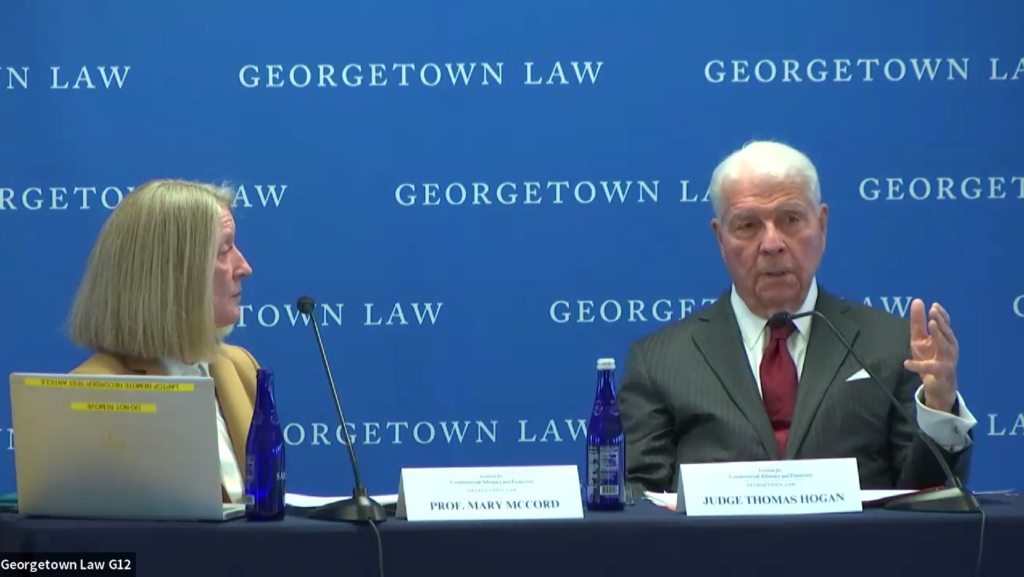
We marked the three-year anniversary of the attack on the U.S. Capitol with a discussion with Judge Thomas F. Hogan, recently retired after 40 years on the D.C. District Court, where he tried and sentenced numerous rioters. Judge Hogan, like so many other federal judges recently, expressed alarm about the spread of the false narrative that January 6 was not a violent attack and the danger that this false narrative will become embedded in our historical understanding of the attack. You can watch and listen to the discussion here.
The three-year anniversary of January 6 also saw the introduction of the Preventing Private Paramilitary Activity Act of 2024 by Senator Markey, Representative Raskin, and several others. The bill was the result of more than two years of ICAP working with the legislators to craft a comprehensive tool for shutting down dangerous paramilitary activity that threatens participation in democratic processes. ICAP’s work on this federal legislation parallels its work with states like Oregon, that have also passed a version of the bill.
Keep up with ICAP on Twitter via @GeorgetownICAP; and suggest what we should take on next via reachICAP@georgetown.edu.With thanks for your continued support, The ICAP Team.