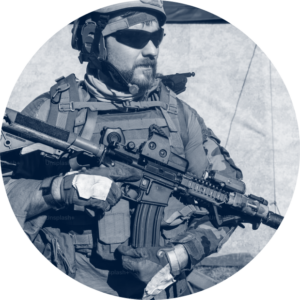
Unauthorized, armed private paramilitary groups present a threat to public safety. This guidance clarifies that armed, coordinated paramilitary activity is not authorized under federal or state law, is not protected by the Second Amendment and is unlawful in all 50 states. Moreover, it presents a threat to public safety— and officer safety—and inhibits free expression and peaceful assembly.
- Unauthorized paramilitary activity is unlawful. Groups of armed individuals that engage in paramilitary activity or law enforcement functions outside the control of any government authority are acting as unauthorized private militias. They often project authority over others by usurping the functions of law enforcement or lawful state militias, such as by claiming that they are protecting property or engaging in crowd control.
- A “well regulated militia,” as used in the U.S. and state constitutions, historically has meant regulated by the government and answerable to the government.
- The Second Amendment’s individual right to bear arms for self-defense, even in a state that permits the open-carrying of firearms, does not protect organized, armed private paramilitary activity, as the Supreme Court held as far back as 1886, and restated in 2008.1
- All 50 states prohibit private, unauthorized groups from engaging in activities reserved for the state militia, including law enforcement activities.2
- Although private paramilitary organizations often seek to recruit law enforcement officers and members of the military, participating in private paramilitary activity is illegal and can result in termination of one’s employment and criminal consequences.
- Unauthorized paramilitary organizations make contentious situations more dangerous for the public and for law enforcement.
- Unauthorized paramilitary groups are not law enforcement. They are not trained, regulated, or subject to public accountability in the same way as law enforcement officers.
- Groups of armed individuals add volatility to often tense situations, such as when demonstrators and counter-demonstrators protest against one other. It is more difficult for law enforcement to maintain public safety and order when the risk of serious violence is amplified by the presence of armed groups.
- Law enforcement agencies should not encourage or facilitate the presence of any unlawful paramilitary activity.
- Unauthorized paramilitary groups sometimes contact law enforcement in advance of public demonstrations to offer their “assistance.” Law enforcement official should make it clear that they do not accept or want this assistance.
- Law enforcement should also make clear to these groups and to the public that unauthorized paramilitary organizations have no authority to engage in law enforcement activities.
- Law enforcement officers should not take sides—and should not appear to take sides.
- In advance of any planned demonstrations, law enforcement should engage in cooperative and strategic advance communication with community stakeholders in order to promote public safety and build mutual trust. Communications should engage members of law enforcement, mutual aid partners, community groups, protest leaders, and event organizers for any demonstrations or counter-demonstrations.
- Taking photos with and expressing appreciation for unauthorized paramilitary groups gives the appearance of endorsing their actions and can both antagonize counter- demonstrators and embolden paramilitary actors.
- Although it is understandably difficult to be confronted by demonstrators who are critical(sometimes virulently so) of law enforcement, maintaining neutrality and professionalism is critical to protecting public safety. Cooperation with law enforcement depends on officers being perceived as fair, respectful, and restrained in their responses to crowd activity.
- Law enforcement agencies should plan ways to mitigate officer stress and fatigue, including ensuring adequate food, water, protection from the weather, and breaks.
- Local officials should consider whether to enforce existing regulations for public demonstrations, include permitting requirements, to ensure fair treatment of all groups and to improve law enforcement officials’ and organizers’ ability to make appropriate preparations to protect public safety while promoting bona fide First Amendment activity.3
- Where local officials have exercised discretion not to enforce existing regulations during demonstrations this year and decide to enforce those regulations again, officials should announce publicly that they will do so going forward.
- Any regulations should be enforced in an even-handed manner, regardless of who is organizing or promoting the demonstration.
- Regardless whether permitting restrictions are in place, officials should consider imposing reasonable time, place, and manner restrictions that are narrowly tailored to serve the government’s compelling interest in protecting public safety. Any restrictions must not be applied in a manner that discriminates based on viewpoint. Such restrictions could include:
- Separating opposing groups and setting up buffer zones;4
- Banning items that can be used as weapons (if permitted by state and local law); and
- Barring private paramilitary activity.
- See Presser v. Illinois, 116 U.S. 252 (1886); District of Columbia v. Heller, 554 U.S. 570 (2008). ↩︎
- Find more information about your state’s anti-paramilitary laws at http://bit.ly/50factsheets. ↩︎
- For more information, see Institute for Constitutional Advocacy and Protection, Georgetown University Law Center, Protests and Public Safety: A Guide for Cities and Citizens, https://constitutionalprotestguide.org/. ↩︎
- Olivieri v. Ward, 801 F.2d 602, 607 (2d Cir. 1986). ↩︎