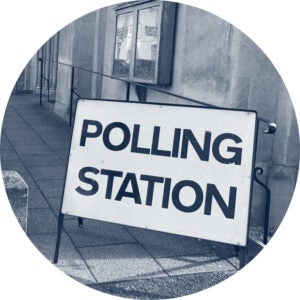
Election officials are on the front lines of protecting voters’ rights to cast their ballots. This guidance provides steps election officials can take to prevent and address voter intimidation at the polls. Officials should exercise sound judgment based upon the facts of a particular situation and respond immediately to disruptive conduct. If possible, consult and coordinate with law enforcement, prosecuting officials, and legal counsel in advance to develop a response plan.
Applicable Federal and State Election Laws
Voter intimidation is a crime under federal law and under every state’s laws.1 Voter intimidation is conduct that is intended to compel prospective voters to vote against their preferences, or to not vote at all, through activity that is reasonably calculated to instill fear. Voter intimidation is unlawful both inside and outside of any no-electioneering zone. Examples may include2:
- Violent behavior inside or outside the polling site.
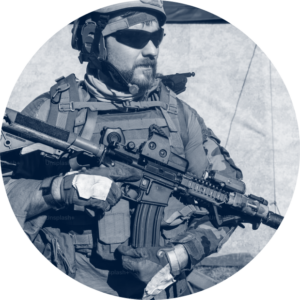
- Confronting voters while wearing military- style or official-looking uniforms.
- Brandishing firearms or the intimidating display of firearms.
- Following voters to, from, or within the polling place.
- Verbal threats of violence.
- Spreading false information about voter fraud, voting requirements, or related criminal penalties.
- Aggressively approaching voters’ vehicles or writing down voters’ license plate numbers.
- Harassing voters, aggressively questioning them about their qualifications to vote.
- Most states prohibit electioneering within the immediate vicinity of the polling place.3 Election officials may enforce electioneering laws even if First and Second Amendment rights are restricted.4
- State and local law may restrict the carrying of firearms within or in the immediate vicinity of the polling place. State law may also prohibit brandishing firearms or using firearms to intimidate.5
- State law defines who may act as a “poll watcher” or “election observer” and who may challenge a voter’s qualifications to vote at the polls.6
- State law may criminalize attempts to intimidate, bribe, or impede the functions of poll workers.7
What Can Election Officials Do if Armed Individuals or Groups are Near Polling Places?
State law often charges election officials with the primary authority to maintain order at the polls. Election officials may approach armed individuals or groups near a polling place and ask, “Why are you here?”
- If the answer is to patrol the line of voters, protect against voter fraud, enforce the law, or a similar response, you may ask the individual or group to stop the activity because they are not authorized to engage in law enforcement functions. Moreover, armed militia activity is not protected by the Second Amendment.8
- If the answer is to challenge voters’ qualifications or a similar response, you may ask the individual or group to stop the activity unless they are authorized under state law. Openly armed individuals or groups do not have authority to intimidate voters by making direct challenges to voters’ qualifications outside a polling place.
- If the answer is to exercise their First or Second Amendment rights, you may nonetheless ask the individual or group to put away their firearms or move away from the line of voters if their presence is intimidating to voters. Election officials may contact law enforcement to assist in protecting public safety or to investigate possible criminal activity and make arrests.
- What Else Can Election Officials Do to Prevent Voter Intimidation Near Polling Places?
- Election officials may impose reasonable time, place, and manner restrictions that are narrowly tailored to serve the government’s compelling interest in protecting against voter intimidation. Any restrictions must not be applied in a manner that discriminates based on viewpoint. Such restrictions could include:
- Moving individuals or groups who are shouting, chanting, or waving large banners to a location further from voters, but still within earshot. Where possible, election officials should consider in advance what locations near the polling site would be most appropriate for such demonstrations.
- Directing openly armed individuals or groups to put away their weapons or move further away from voters.
- Ensuring all pathways to enter and exit the polling location, including to and from the parking lot, are clear and unimpeded, except for those waiting in line to vote.
- Separating opposing groups and setting up buffer zones.11
- Election officials may impose reasonable time, place, and manner restrictions that are narrowly tailored to serve the government’s compelling interest in protecting against voter intimidation. Any restrictions must not be applied in a manner that discriminates based on viewpoint. Such restrictions could include:
1 18 U.S.C. §§ 245(b)(1)(A), 594, 20511(1).
2 Inst. for Const. Advocacy and Protection, Fact Sheet: Protecting Against Voter Intimidation, available at https://icap.law.georgetown.edu/wp-content/uploads/2026/02/Voter-Intimidation-Fact-Sheet.pdf.
3 See Nat’l Ass’n of Secretaries of State, Electioneering Prohibitions Near Polling Places (Dec. 2023), https://www.ncsl.org/elections-and- campaigns/electioneering-prohibitions.
4 See Burson v. Freeman, 504 U.S. 191 (1992).
5 See Giffords Law Center to Prevent Gun Violence, Location Restrictions (accessed Aug. 7, 2024), https://giffords.org/lawcenter/gun- laws/policy-areas/guns-in-public/location-restrictions/. The Supreme Court has “assume[d] it settled” that firearms can be banned at polling places. New York State Rifle & Pistol Ass’n v. Bruen, 597 U.S. 1, 30 (2022).
6 See Nat’l Ass’n of Secretaries of State, Poll Watchers and Election Observers (May 2024), https://www.ncsl.org/elections-and- campaigns/poll-watchers-and-challengers.
7 See, e.g., Md. Code Ann. Elec. Law § 16-204–06; N.C. Gen. Stat. § 163-275(11); Kan. Stat. Ann. § 25-2418; Tenn. Code Ann. § 2- 19- 125.
8 District of Columbia v. Heller, 554 U.S. 570 (2008); Presser v. Illinois, 116 U.S. 252 (1886). Find more information about your state’s anti-paramilitary laws at http://bit.ly/50factsheets.
9 Embody v. Ward, 695 F.3d 577 (6th Cir. 2012); Deffert v. Moe, 111 F. Supp. 3d 797 (W.D. Mich. 2015); Baker v. Schwarb, 40 F. Supp. 3d 881 (E.D. Mich. 2014); Baker v. Smiscik, 49 F. Supp. 3d 489 (E.D. Mich. 2014); Chesney v. City of Jackson, 171 F. Supp. 3d 605 (E.D. Mich. 2016); see also Giboney v. Empire Storage & Ice Co., 336 U.S. 490 (1949); United States v. Matusiewicz, 84 F. Supp. 3d 363 (D. Del. 2015).
10 See, e.g., Va. Code Ann. § 24.2-607.11 Olivieri v. Ward, 801 F.2d 602, 607 (2d Cir. 1986).