
newsletter 06/26/24
We’re not slowing down this summer!
Institute for Constitutional Advocacy and Protection
GEORGETOWN LAW
ICAP is kicking off the summer season with a bang—we’ve just filed a case challenging Georgia’s new restrictions on paying charitable bail, and we’ve taken on important cases in the democracy-protection space. We’ve also seen recent Supreme Court victories in cases for which we filed friend-of-the-court briefs, though we’re still waiting on the results in many important cases before the high court.

Fighting the criminalization of poverty
In partnership with the ACLU of Georgia, ICAP filed suit over the weekend seeking an emergency order to stop a new law in Georgia that severely restricts paying cash bail for those too poor to pay. Georgia Senate Bill 63, set to take effect on July 1, would limit individuals and charitable bail funds to making no more than three cash bail payments a year and force them to comply with all requirements applicable to bail bondsmen (notwithstanding that charitable bail is the full payment of bail, not a mere bond promising to pay if the person arrested fails to return to court). The lawsuit, brought on behalf of a non-profit charitable bail fund in Atlanta and two people who run a similar fund through their church in Athens, argues that SB 63’s restrictions violate First Amendment rights to freedom of speech, association, and religion. We’ll be in court this Friday to argue for emergency relief that would stop SB 63 from taking effect and allow charitable bail activity to continue.

Protecting democratic processes
Earlier this month, ICAP entered the direct democracy fight in defense of a Sixth Circuit decision that ordered the Ohio Attorney General to forward a proposed constitutional amendment to the state’s ballot board—a necessary first step in the process of getting a citizen-sponsored initiative on the ballot. The attorney general had refused seven times to approve the ballot initiative, thwarting our clients’ ability to even start the process of getting the required number of signatures in time for the measure to be included on the November ballot. The Sixth Circuit has now decided to hear the case en banc (which means before the full court and not just a panel of three), and we’ll be arguing for the First Amendment rights of the plaintiffs to engage in core political speech about the proposed amendment.
We’re also fighting to protect a faith-based charity against an overreaching investigation by the Texas Attorney General into the charity’s provision of humanitarian aid to recent immigrants. This is part of an increasing trend of scrutinizing non-profits advocating and supporting civil liberties.
Beyond these new cases, our democracy-protection work continues:
- This month, as a follow-on to our series of regional convenings on political violence, ICAP hosted a virtual reconvening with local, state, and federal public officials, as well as community activists and organizers from the Great Lakes region, where both political conventions will soon take place. Our virtual reconvening included threat briefings by our research partners, legal options for addressing political violence and election-related mis- and disinformation, and legislative initiatives to combat unlawful paramilitary activity. This series of convenings—hosted in-person in 2022 and 2023 in the Great Lakes, Pacific Northwest, Southwest, and the Southeast—has resulted in increased collaboration between public officials and community leaders and many follow-up consultations with ICAP.
- Since the resolution of our groundbreaking case against the Wisconsin fraudulent electors and Trump campaign attorneys James Troupis and Kenneth Chesebro, we’ve worked to broaden public understanding of the scheme through articles detailing the evidence revealed as a result of our case and providing a comprehensive timeline of the plot. And we’ve seen additional efforts toward accountability, with the Wisconsin Attorney General filing felony forgery charges against Chesebro, Troupis, and campaign advisor Mike Roman. To learn more about how our settlement uncovered crucial new evidence about the scope and lawlessness of the plot, check out our pieces in Just Security, linked above, and listen to ICAP Executive Director Mary McCord on the Lawfare podcast, which she recently joined to discuss our suit and the related criminal charges.
Defending Constitutional Rights in the Supreme Court
While we’re on tenterhooks waiting for the Supreme Court’s decision in Grants Pass v. Johnson, argued by Supreme Court Director Kelsi Brown Corkran on behalf of homeless residents punished by the city for sleeping in public with as little as a blanket for warmth, we’ve been pleased with the outcome of two cases in which ICAP filed amicus briefs:
- In Gonzalez v. Trevino, the Supreme Court reversed the Fifth Circuit’s dismissal of a First Amendment retaliation claim brought by a 72-year-old city councilwoman who was arrested after criticizing the city manager. ICAP had supported the councilwoman with an amicus brief filed with our partners at the Constitutional Accountability Center.
- In Moore v. United States, the Supreme Court upheld the constitutionality of the “mandatory repatriation tax” enacted in 2017 to allow for the taxation of American shareholders on certain undistributed income of American-controlled foreign corporations. Our brief, filed with Georgetown Law Professor Brian Galle on behalf of professors of tax law, legal history, and computational science, supported that result. The case had important implications for the definition of “income” that could have reverberated well beyond the tax law at issue.
Although not our case, we were gratified to see the Supreme Court’s decision in United States v. Rahimi, rejecting a Second Amendment challenge to a federal statute that sensibly prohibits people found to be a threat to others and subject to a domestic violence restraining order from possessing firearms. Rahimi is the first Supreme Court opinion to offer guidance on the scope of the Second Amendment since the Court’s 2022 decision in Bruen, which has sparked much litigation—leading to ICAP’s defense of a ban on firearms in sensitive places enacted by the state of Hawai’i, as well as its amicus support for other local and state sensitive-place bans (most recently, in Virginia state court) and bans on assault-style rifles and high-capacity magazines. We will continue to argue in support of reasonable gun-safety measures, including by filing an amicus brief in the Supreme Court next week in a challenge to the ATF’s regulation of ghost guns.
For those tracking other Supreme Court opinions we’re waiting on (some of which may be released between the time we send this email and the time you read it!), you can listen to Mary on NPR’s 1A discussing the presidential immunity case with University of Michigan Law Professor Leah Litman and the anticipated decisions in other major cases with NYU Law Professor Melissa Murray.
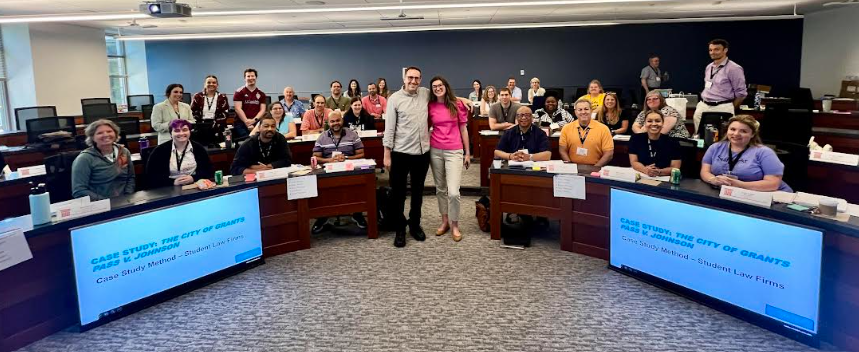
Finally, several of ICAP’s attorneys have been paying it forward by volunteering with the Supreme Court Summer Institute for Teachers. This program is hosted by Street Law and the Supreme Court Historical Society, and aims to strengthen classroom instruction about the Court and its cases. Using Grants Pass as a case study, ICAP’s Joe Mead and Shelby Calambokidis worked with secondary school social studies teachers as part of a “student law firm” exercise and helped coach them in crafting persuasive legal arguments. A good time was had by all!
Keep up with ICAP on Twitter via @GeorgetownICAP; suggest what we should take on next via reachICAP@georgetown.edu, and make a gift at Donate to ICAP.
With thanks for your continued support, The ICAP Team.